

Among the numerous divine practitioners of the sacred sayings present in the traditions of Indian spirituality, Aum and Shri are attributed a special status. They refer to auspiciousness, divine intelligence, purity, abundance, and spiritual practice. Although they are frequently employed in religious prayers, the significance goes beyond mere worship and is deeply tied to philosophical concepts of creation and existence.
Aum: The Holy Sound of Awareness
Aum or Om is seen as the holy sound in the philosophy of Hinduism. It is used as a prefix in prayers, mantras, and names of gods to indicate purity and auspiciousness. The tradition of chanting and meditating on Aum is considered to bring tranquility to the mind.
Aum is given a deep philosophical meaning in the Upanishadic tradition, as it is identified with Brahman, the supreme reality. It is also associated with Pranava, i.e., the primordial sound that relates to consciousness and life.
Its three principal sounds—A, U, and M—are traditionally connected with three ordinary states of consciousness: waking, dreaming, and deep sleep. The stillness that follows the audible noise signifies a different and higher state of being than what is simply available in consciousness at the current moment. Therefore, although Aum seems like a mere sound, it conveys the idea of consciousness.
The idea of the nature of Aum goes beyond Hindu principles. Similar concepts can be found in Buddhism, Jainism, and Sikhism.
Shri: a Sign of Good Luck
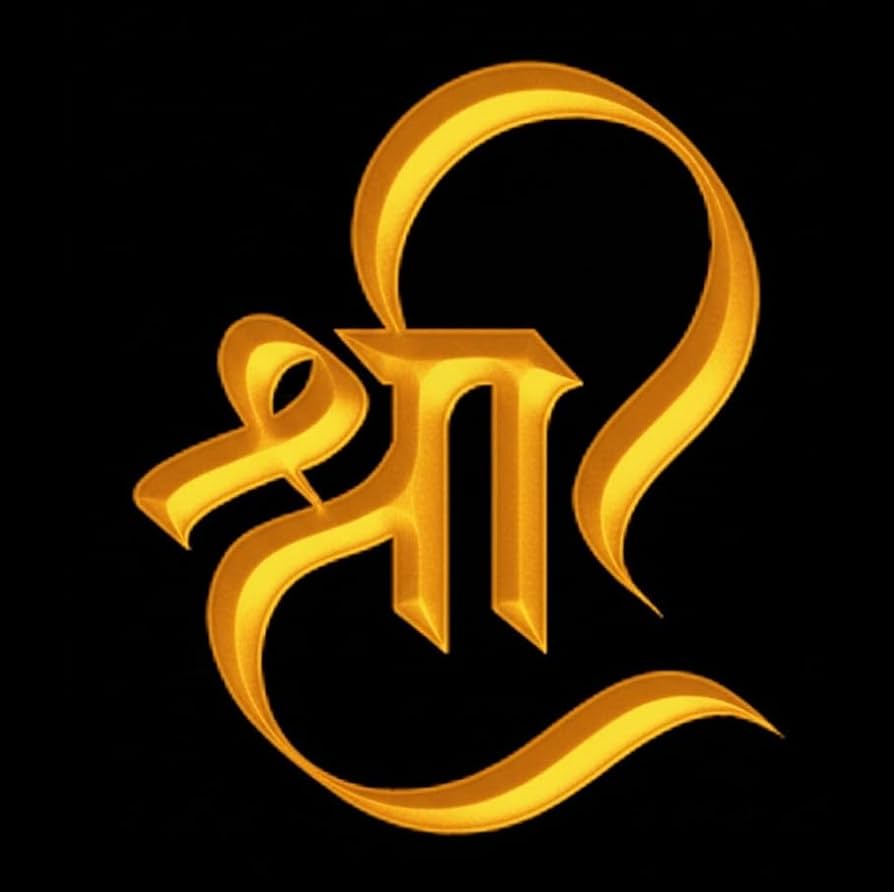
Shri or Sri is another popular word in Sanskrit and is used in connection with deities and other people to refer to someone lucky. It is associated with the goddess Lakshmi, whose name brings together all concepts of wealth, richness, beauty, success, and health.
This is why expressions such as Shri Vishnu, Shri Krishna, Shri Ganapati, and Shri Devi are commonly encountered in devotional traditions. The word can also convey qualities such as dignity, magnificence, grace, excellence, prosperity, and spiritual radiance.
In everyday Indian usage, “Shri” continues to function as an honorific, demonstrating how an ancient sacred expression has also become part of social and cultural language.
The Symbolism Behind Shri
Traditional interpretations connect Shri with the sounds Sha or Shi and Hri. These are given symbolic associations with masculine and feminine divine principles. In philosophical concepts, this could symbolize the merger of Purusha, awareness, with Prakriti, creative energy.
The syllable Hrim is quite significant in the traditions of Shakti and Tantra. Hrim is known as a powerful beeja mantra linked with the Divine Mother; it is associated with consciousness, creative power, knowledge, beauty, and spiritual change.
From those meanings, Shri can be interpreted as the harmonious interaction of consciousness and creative power—the forces through which existence manifests and is sustained.
Shri Vidya

One of the important traditions related to Shri is Shri Vidya, which is the path based on the worship and meditation on the Divine Mother. The Goddess may be seen as the highest reality in the systems of Shaktism and is worshipped in different forms.
Shri Vidya combines devotional practices, meditation, sacred mantras, and philosophical contemplation. Traditional practitioners may follow different approaches, and initiation and guidance from an experienced teacher have historically been considered important within the tradition.
Shri Chakra and Shri Yantra
The Shri Chakra, also called the Shri Yantra, is one of the best-known sacred diagrams associated with Shri Vidya. The image comprises interrelated triangles that are bordered with trails of lotus flower petals and geometric designs, thereby forming the boundaries of the whole design.
Traditionally, the image has been interpreted in terms of the Goddess, creation, and the relationship between the universe and an individual. The triangles indicate the opposing cosmic principles, while the outer structures refer to the various dimensions of existence.
The Shri Chakra plays a crucial role in meditation and ritual worship, and is commonly applied in temples and homes of the Shakta tradition, either in the two- dimensional or three-dimensional forms.
Shrinivasa and Shri Kshetra
The name Shri has found its expression in several traditional names and places of worship in Sanskrit. One of the most popular names is Shrinivasa, which refers to Lord Vishnu. It denotes the divine presence from the heart of Lakshmi as well as from the hearts of devotees.
The expression Shri Kshetra signifies a holy place or location of Shri. For instance, the city of Puri in Odisha is traditionally known as Shri Kshetra because of the famous Jagannath Temple in the city.
About the Author


