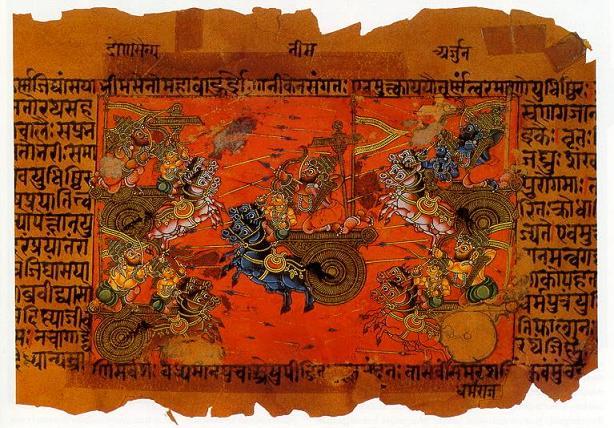
The Mahabharata, one of the longest epic poems in the world, has captivated generations with its tales of heroic deeds, divine interventions, and complex moral dilemmas. However, the question of whether the Mahabharata is a historical account or a work of mythology remains a subject of debate among scholars, historians, and enthusiasts. Examining the historical authenticity of the Mahabharata involves navigating through a blend of mythology, archaeology, and historical interpretation.

The Epic and Its Origins
The Mahabharata, traditionally attributed to the sage Vyasa, is a massive epic that consists of over 100,000 shlokas (verses) divided into 18 parvas (books). It narrates the story of the Kuru dynasty, focusing on the Kurukshetra War between the Pandavas and the Kauravas. While the epic is considered a foundational text in Hindu philosophy and mythology, the challenge lies in establishing its historicity.
Archaeological and Literary Evidence
Kurukshetra and Dwarka:
Archaeological excavations have unearthed sites believed to be associated with the Mahabharata. Kurukshetra, the legendary battlefield, has been identified as a real location in present-day Haryana, India. Similarly, the submerged city of Dwarka off the coast of Gujarat is often linked to the Mahabharata’s city of Dwaraka. These findings provide intriguing correlations but fall short of definitive proof.
Literary Interpretation:
The Mahabharata contains astronomical references and geographical details that some interpret as potential historical markers. For example, descriptions of celestial positions and events have led some scholars to explore the possibility of dating certain episodes using astronomical software. However, these interpretations are subject to various assumptions and can be contentious.
Historical Perspectives
Tradition vs. Skepticism:
Traditionalists argue that the Mahabharata is a historical account with embellishments of myth and legend. They point to the presence of detailed genealogies, descriptions of kingdoms, and the inclusion of historical personalities. Skeptics, on the other hand, view the epic primarily as a literary and philosophical work, emphasizing its symbolic and allegorical aspects.
Multiple Retellings:
The Mahabharata has undergone numerous retellings and adaptations over the centuries, making it challenging to discern historical truths from later embellishments. The oral tradition, coupled with the vast expanse of time between the events described and the composition of the text, adds layers of complexity.
Lack of Concrete Evidence
Despite the intriguing correlations and interpretative efforts, a definitive historical proof of the Mahabharata remains elusive. The absence of concrete archaeological evidence directly linking to the events described in the epic leaves room for skepticism. The challenge lies in reconciling the rich mythological tapestry with the historical reality, if any.
Conclusion
The question of whether the Mahabharata is real or a product of myth and allegory is deeply rooted in the complexities of historical interpretation. While archaeological discoveries and literary analyses offer intriguing insights, they fall short of providing conclusive evidence. The Mahabharata, whether a historical account or a profound work of literature, continues to inspire contemplation, debate, and spiritual reflection, transcending its status as a mere epic to become a cultural and philosophical touchstone for millions.




Leave a Reply