Introduction
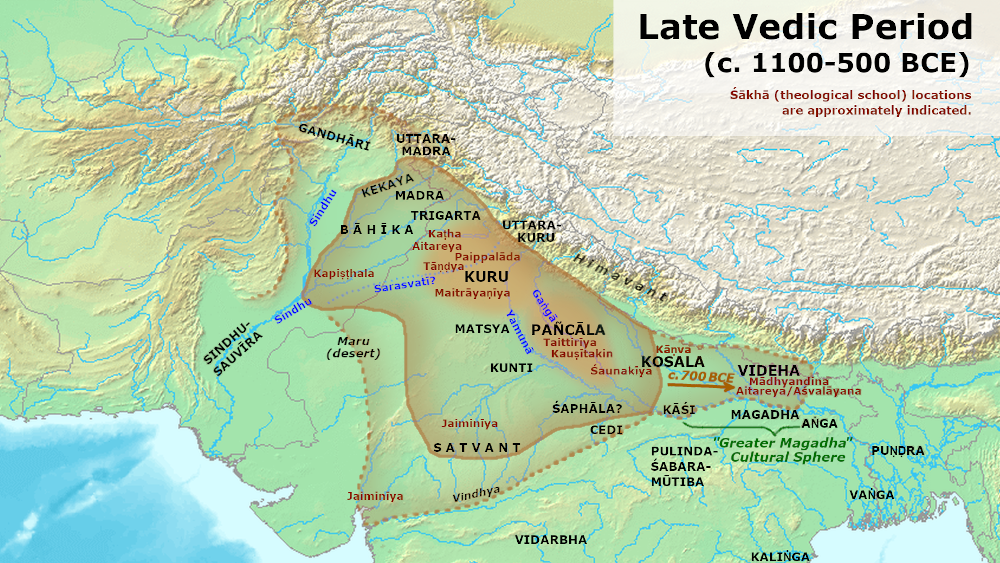
In the ancient past, the Kingdom of Anga was a very large and powerful state in the Indian subcontinent. At the time of the early Iron Age, it was at the peak of its game, which it did from what is today central Bihar and into parts of Bengal. Also known to have had its capital in Champa (which was also known as Malini), which was a great centre of power, trade, and culture. As one of the sixteen great Mahajanapadas, Anga was a key player in the political and social structure of what we today call South Asia before it slowly came under the Magadhan Empire.
Mythological Origins and Lineage
The Anga’s origins are rooted in the mythological past of ancient India. In the Mahabharata, we are told that the kingdom was founded by the eponymous King Anga. He is said to be the son of King Vali, which in turn places him within the Magadha line. Also, it is said that five separate royal houses, Anga, Vanga, Kalinga, Pundra, and Suhma, were founded by five brothers, all descendants of Vali.
In the early Vedic age, the people of Anga were a separate culture from that of the Vedic Aryans. The Atharva Veda reports on the Angas’ use of the term Mlechas, which it applied to non-Indo-European groups living outside Vedic customs. This difference indicates that Anga had a non-Vedic culture, which only at a later date came under or fell to the influence of the Aryan traditions.

The story of Karna in the Mahabharata.
Perhaps in the popular memory, the Anga kingdom is known for its great hero, Karna, from the Mahabharata. In that which is told, the Kuru prince Duryodhana’s aim to challenge the Pandavas saw him bestow the Anga throne upon his friend Karna. At the time, Anga was probably a collection of sub-regions. This installation may also represent a historical Indo-European political push into eastern areas.
Karna is noted for his military strength, which he used to rule. Also of note is the fact that he was given the city of Malini from Jarasandha, the great king of Magadha, which in turn was renamed Champa. Also, his line passed through his son Vrishasena, who, we are told, was the Chief of the Angas at the time; thus, we see the hereditary quality of the monarchy, which was put in place at this time.
Religious and Cultural Significance
Beyond its military past, Anga has a special place in religious history. In the Ramayana, we see a different legend related to the name of the kingdom. It is said that here Lord Shiva, in a fit of rage, reduced Kamadeva (the God of Love) to ashes. This myth, which is out of the ordinary, gives the region a spiritual importance.
Geographically, Anga served as a trade and commerce hub. Its location at the eastern edge of Magadha\’s border played a role in its becoming a centre for river trade, which in turn brought in great wealth. But this also brought Anga into a continuous political struggle with the assertive Magadhan state, which in the end played a large role in determining Anga’s fate.
The Dynastic Succession
While we may not have exact dates on the very early kings’ reigns, which the ancient texts do not provide in great detail, in the Puranas and other literature, we find mention of certain rulers. Also among the line of Anga and that of the famous Karna were kings like Lomapada, who at the same time was a friend and contemporary of King Dasaratha of Kosala. Also of note are Chitraratha, Vrihadratha, and Vasuhoma.
During the 6th century BC, the timeline comes into better focus. Kings like Dhatarattha and Dhadivahana are reported to have ruled at that time. These rulers, in turn, preserved the independence of Anga, which they did through skill in diplomacy.

The Fall of Anga
The independent history of Anga came to an end with the rise of the Magadhan Empire. King Bramhadatta, the last independent ruler of Anga, which was in the middle of the 6th century BC, ruled. Although Anga was a rich and powerful state, it could not stand up to its neighbouring empire.
Around 500 BC, Magadha’s heir apparent, Bimbisara, who at the time also functioned as a viceroy for his father, put forth a definitive campaign against Anga. Bramhadatta fell in battle, and the kingdom came under Magadha’s control. That was a turning point in Indian history, which saw the start of Magadha’s rise to preeminence in the subcontinent. After the annexation, Anga no longer existed as an independent state but was instead integrated into the Magadhan administration, although its past as a cultural and trade centre did not fade for hundreds of years.




Leave a Reply