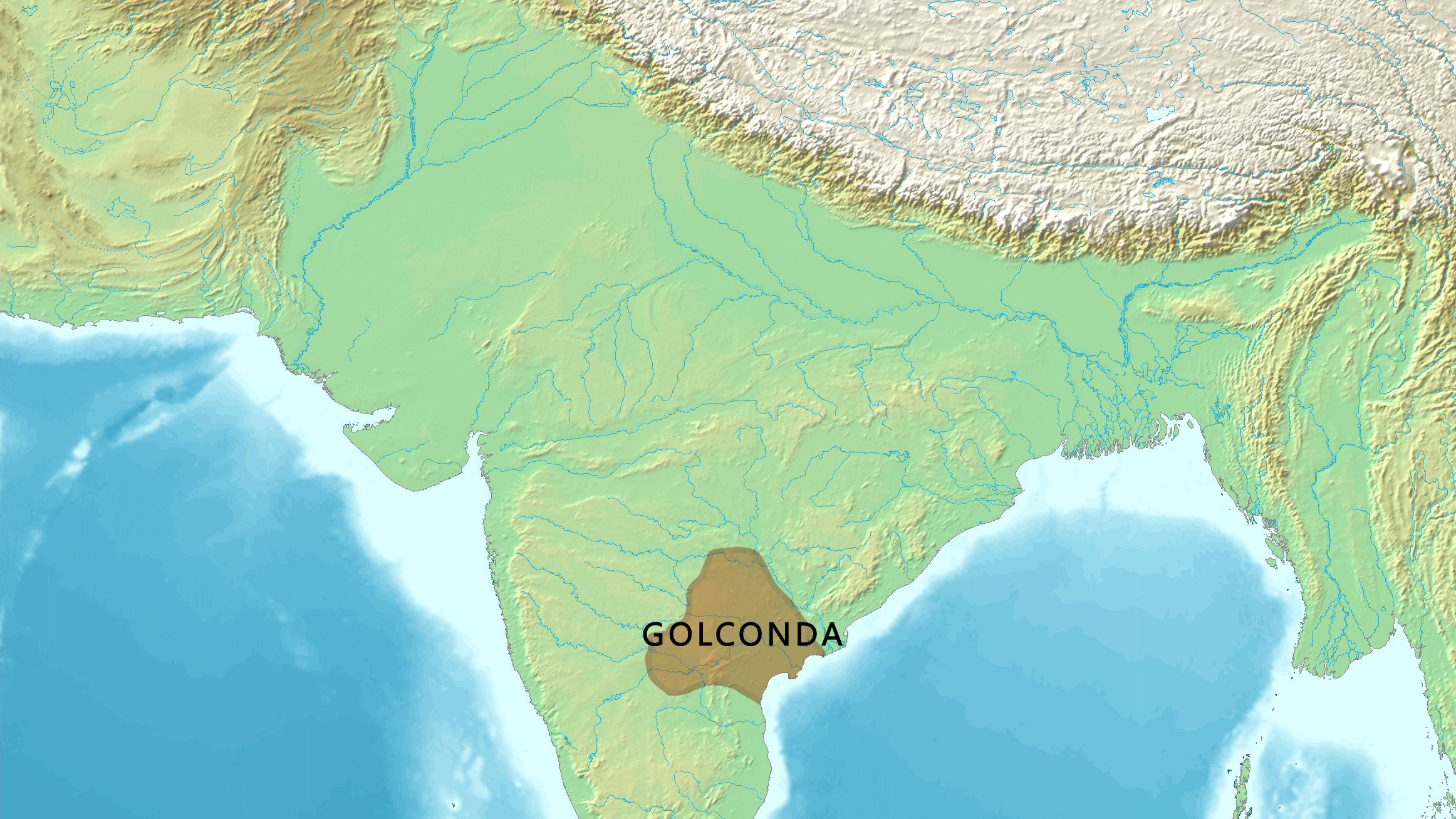
In the history of the Deccan plateau in Central India, the Kingdom of Golconda is a monumental chapter. Out of the Bahmani Sultanate’s break-up in the early 1500s, it rose to become a centre of culture, architecture and power under the Qutb Shahi dynasty. Situated in what is present-day Telangana and Andhra Pradesh, Golconda’s legacy is in its great forts, the foundry of Hyderabad, and its dramatic relationships with the Mughal Empire.
Rise of the Qutb Shahi Dynasty
In the 1518’s, the origin of the independent Kingdom of Golconda is reported. What was then a province of the Bahmani Sultanate, which sat between the Godavari and Krishna rivers, saw that report. As the Bahmani power structure broke into five separate sultanates, Quli Qutb-ul-Mulk, the Telangana governor, took the chance to break away and declare independence.
Quli Qutb-ul-Mulk founded the Qutb Shahi dynasty, which he titled Qutb Shah. His rule, which lasted from 1518 to 1543, saw great expansion. He put together large parts of his empire by way of conquest, which included Warangal, Kondapalli, Eluru, and Rajahmundry. But his end was violent at the hands of his son Jamsheed, which in turn caused his other son Ibrahim to seek refuge in the Vijayanagara Empire.

Consolidation and Cultural Flourishing
Following the short and turbulent rule of Jamsheed and the removal of his infant son Subhan, Ibrahim Quli Qutb Shah came back in 1550 to take the throne. His reign (1550- 1580) was a turning point for the kingdom. Ibrahim put more of his effort into the structure of the country’s infrastructure, which also included the fortification of what has become the famous Golconda Fort that sits on top of a 122-meter granite hill. Also, he improved the region’s hydrology and aesthetics by developing the Hussain Sagar Lake and the Ibrahim Bagh.
In 1565, the political map transformed at the Battle of Talikota. Golconda, which was but a part of the Deccan sultanates, which also included Ahmednagar, Bijapur and Bidar at that time, played a key role in defeating the Vijayanagara Empire. That victory, in turn, restructured the power in South India.
During the reign of Muhammad Quli Qutb Shah (1580- 1611), the kingdom saw a cultural peak. It is for establishing the city of Hyderabad that he is mainly known, which at that time was a shift out of the walled fortress into a new urban centre, which went on to become famous for its wealth and beauty.
The Mughal Threat and Decline
As the 17th century wore on, the Mughal Empire\’s influence grew over Golconda, which had far-reaching effects for its future. In the early part of the ,1700s Emperor Akbar took control of some of the Deccan territories. By the reign of Abdullah Qutb Shah (1626- 1672), Mughal overlordship became a very real issue. Also in 1636, the Qutb Shahi dynasty was made to put down the rebellions in Ahmednagar, which in turn put them under the Mughal heel.
Tensions grew in 1646 when the King of Golconda had issues with the Mughal governor, Prince Aurangzeb. The Mughals laid siege to the fort, which resulted in a peace agreement that included a marriage between the Qutb Shahi and Mughal royal families. Though they made these concessions, the kingdom managed to retain much of its independence for a few more decades.
The Fall of Golconda

In 1687, at the time of Abul Hasan Qutb Shah’s rule, which was that of the so-called “benevolent king” and also known as Tana Shah, Emperor Aurangzeb had become the preeminent Mughal ruler. When Abul Hasan did not fully accept Mughal overlordship, Aurangzeb launched into a large-scale military campaign.
The Mughal army under Chin Qilich Khan set out and, in the end, broke into Golconda’s defences. Abul Hasan was taken captive and died in prison, which put an end to the Qutb Shahi dynasty. The kingdom fell into the Mughal province, which was to be ruled by Mughal-appointed Nizams.
Legacy and the Asaf Jah Era
The end of the Qutb Shahi rule did not see the end of the area’s importance. In 1720, at a time which saw the Mughal Empire in retreat, a new and powerful state emerged from the ashes. The city of Hyderabad came to be the centre stage of it. Into this political vacuum entered Qamar-ud-din Khan (Asaf Jah I), who founded the Asaf Jahi Dynasty to become the Nizams of Hyderabad. From that point began a new bloodline that ruled for over two centuries, which also served to keep alive the legacy of the Golconda dynasty into modern times.




Leave a Reply