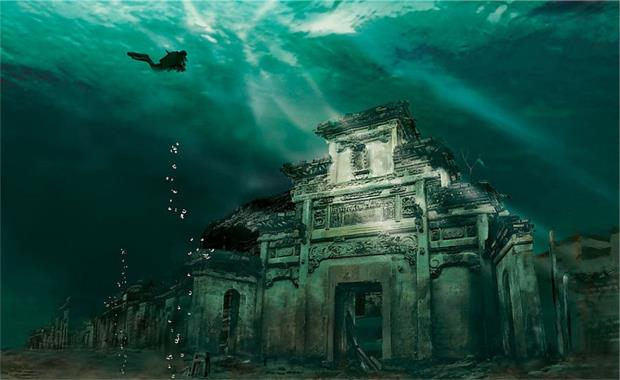
The city of Dwarka has garnered significant attention from archaeologists worldwide. Initially mentioned in the epic Mahabharat as the city of Lord Krishna, Dwarka is believed to have been established by Lord Krishna himself.
However, some historians once argued that Dwarka, along with the existence of Lord Krishna, was merely a myth lacking evidence. This perspective, they claimed, was perpetuated by colonial rulers and later adopted by certain political factions aiming to discredit Hinduism. Their aim was to disconnect present generations from ancient history, portraying Hindu narratives as mythological.

Contrary to these claims, archaeological findings have refuted the notion of Dwarka being a myth. In the 1980s, marine biologists discovered substantial structures beneath the sea, prompting further exploration by marine archaeologists in 1988. Their study focused on identifying massive stone walls along the ancient Gomati River, the architectural similarity to descriptions in the Mahabharat, the confluence of the Gomati River with the sea, and the reasons behind the city’s submersion.
Located in Gujarat, Dwarka, meaning ‘Gateway to heaven’ in Sanskrit, was renowned for its beauty, boasting 900,000 palaces adorned with crystal, silver, and emeralds. The excavation revealed a well-planned city comprising six blocks adorned with precious stones, connected by roads and bridges, featuring marketplaces, temples, assembly halls, gardens, and lakes.

Further evidence, such as large anchor stones, indicated extensive overseas trade via ships. The city, surrounded by water, had ports connecting it to the mainland, facilitating maritime commerce.