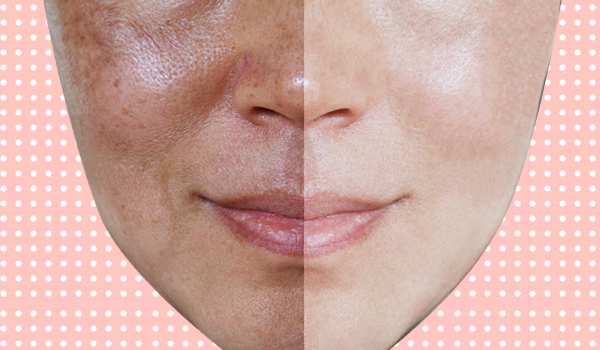

What are these Open Pores?
Open pores are tiny, pit-like gaps on the skin. Everyone has pores on their surface, and when these pore holes get abnormally dilated, they are called ‘open pores’. Open pores resemble small depressions all around the skin, giving an orange-peel texture; hence, these open pores offer a dull, uneven, and aged look to the face.
Open pores are typically observed on the nose and on the sides of cheeks (malar region). In people with oily complexion, they are commonly visible on the outer side of the cheek and forehead, as well.
Be aware that they should not be mistaken with the deeper pits and potholes of acne scars. It may so occur that you have an oily complexion with black/whiteheads and may tend to develop pimples’ breakouts.
How do they appear?

Open pores generally start during the phase of puberty, due to increased oil production from sebaceous/oil glands, which occurs due to the stimulation of the androgen hormone. As a final outcome, these sebaceous gland openings get blocked with dead skin cells and debris. This limits the flow of increased oil, leading to the distension of their openings, which is observed as open pores.
Usually, skin aging causes age marks, but it may also be affected by ultraviolet light exposure coming from sunlight or tanning beds. You tend to grow age spots on the more sun-exposed areas of your skin.
How to eliminate open pores?
There are several treatment options for open pores, but not many pieces of evidence confirm their effectiveness and success rate. Here are various methods:

Retinoids: Oral and topical retinoids (skin lotions) lead to the reduction of open pores and oil secretions, but it is available only by prescription.
Salicylic acid: Beta-hydroxy acid like salicylic can penetrate the sebaceous duct opening, and the keratin plug is removed, helping to minimize open pores. Many over-the-counter toners and face washes with salicylic acid are accessible in the market. These should be used by people who have oily skin. Fortnightly salicylic acid peels may help you manage oil secretion and decrease open pores. However, salicylic acid may not be suitable for sensitive and dry skin types.
Lasers: Certain lasers (e.g., Fractional CO2 laser, Nd YAG Laser) can help lessen open pores. These lasers induce collagen remodeling. They have been used successfully to reduce deeper scars from acne, such as holes and craters. At present, laser treatments for open pores are still to be established.
Derma-rollers: They may help in the closure of open pores by collagen remodeling but are not as effective as lasers.
TCA CROSS Chemical Peels: This is a simple yet effective procedure to reduce open pores with a downtime of 7-10 days. The procedure involves the application of tri-chloro-acetic acid onto the wall of open pores through a toothpick, which results in the formation of black scabs over each treated pore that falls off in 7-10 days.It provides good outcomes as pore size is reduced by 30-50%. If needed, multiple treatment sessions may be conducted.
Microdermabrasion: This technique helps in eliminating the external layer of skin by scrubbing the blackheads. Then, the remaining dust and oil from the pores are sucked out with a vacuum. Additionally, microdermabrasion causes collagen remodeling that leads to an increase in skin elasticity, tightening the pores. The pores return to their regular shape and size as the natural oil reaches the skin surface, with nothing but the natural oil stuck inside that could make the pores enlarge.
About the Author


